|
|||||||||||||||||||||||||||||||||||||||||||||||||||||||||||||||||||||||||||||||||||||||||||||||||||||||||||||||||||||||||||||||||||||||||||||||||||||||||||||||||||||||||||||||||||||||||||||||||||||||||||||||||||||||||||||||||||||||||||
Freshwater Molluscan Shells / North American Pleuroceridae
Burch (1982) provided the following breakdown for North American species, here tabulated. (now superceded, see below). Please also see
http://fwgna.blogspot.com/2004/09/goniobasis-and-elimia.html and
http://fwgna.blogspot.com/2011/03/goodbye-goniobasis-farewell-elimia.html
for a discussion on the use of the names Elimia and Goniobasis for the smaller high-spired snails
Genus Subgenus number species additional
subspeciesElimia 83 27 Gyrotoma* 6 Io 1 variable Leptoxis Leptoxix s.s.
Athearnia*
Mudalia16
1
6Lithasia Lithasia s.s.
Angitrema3
7Pleurocera Pleurocera s.s.
Strephobasis*18
39
1Juga Juga s.s.
Calibasis
Oreobasis
___________3
2
4
________1
2
0
_____Totals 10 153 40 *Largely extinct due to dam construction.
Many names can be found in the literature not included in Burch's compilation, particularly in "Elimia", so the actual number of names that have been applied may be huge..
More recently, Dillon (2011) has continued a long trend in freshwater malacology in recognizing fewer species than formerly, but with wider geographic ranges and more variable morphologies. DNA evidence shows many of the species listed by Burch to be synonyms, so the actual number of species is probably less than shown here. In addition, also based based on DNA evidence, Elimia (or Goniobasis) can no longer be recognized as a valid genus, and its included species should be subsumed under a more inclusive genus Pleurocera. Nomenclature is in flux, and claiming to name the specimens shown here with certainty would be wrong.
Dillon, R. T., Jr. (2011) Robust shell phenotype is a local response to stream size in the genus Pleurocera (Rafinesque, 1818). Malacologia 53: 265-277Also note: the Juga snails of the Pacific Northwest (formerly also included in Goniobasis by many authors) have been reclassified with the east-Asian family Semisulcospiridae. See
http://www3.interscience.wiley.com/journal/122198254/abstract?CRETRY=1&SRETRY=0#fn1
Tributaries of the Ohio
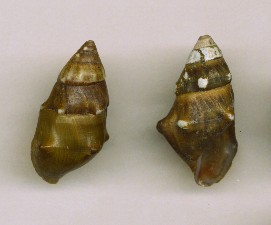
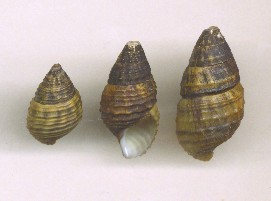
Pleurocera canaliculatum (Say, 1821) (?) detail
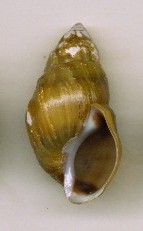
Pleurocera canaliculatum (Say, 1821) (?) "Hornshell"
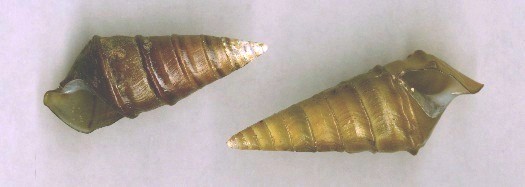
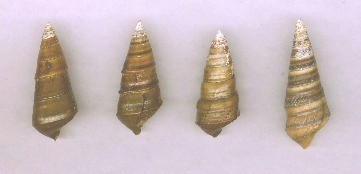
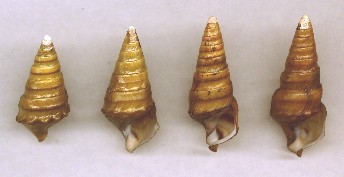
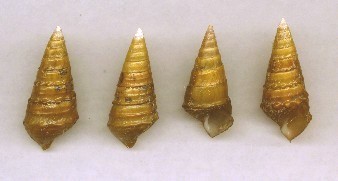
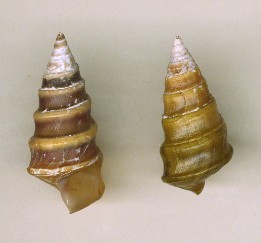
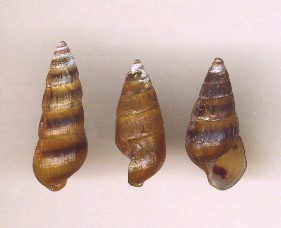
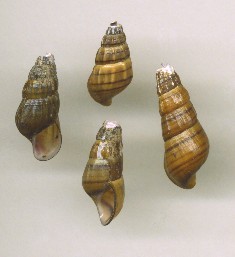
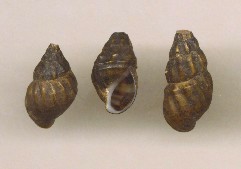
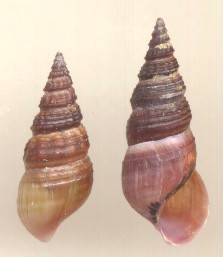
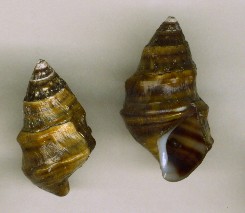
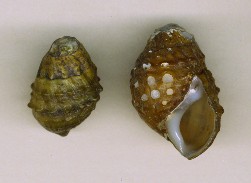
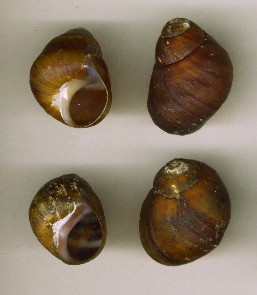
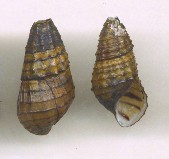
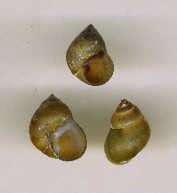
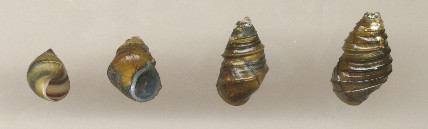
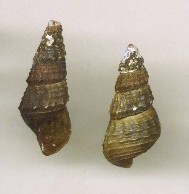
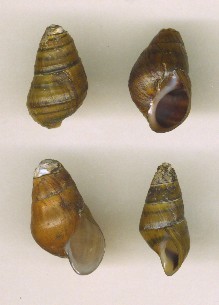
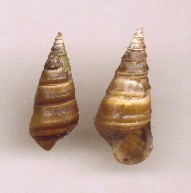
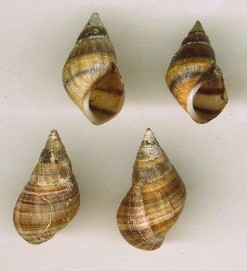
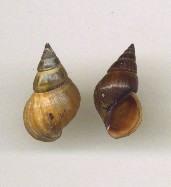
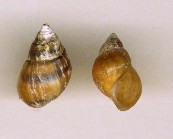
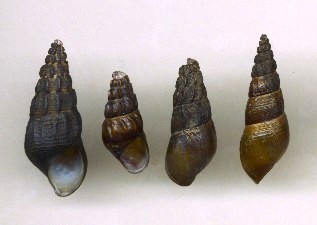
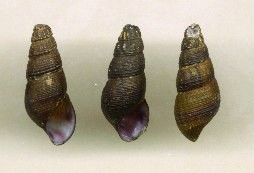
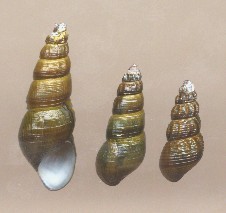
Many species and varieties, or one variable species? Those in the upper Tennessee River, in Watts Bar and Chickamauga Lakes (upper images, left and right respectively) may be smooth, and/or nodular, and/or shouldered. Those in Kentucky Lake, on the lower Tennessee River (left) are more uniformly conical and nodular, with spiral cords on the base of the body whorl, and may not have a spiral color band.
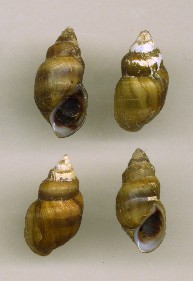
Pleurocera canaliculatum(?) (Say, 1821)
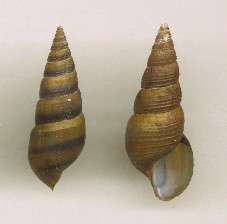
Stairstep shouldered form living in Duck RiverPleurocera parvum (Lea, 1862) highland
tributaries of Tennessee River.
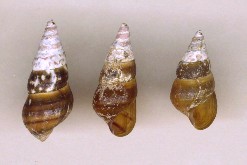
Pleurocera strigosa (Lea, 1841)*
East Tennessee creeks. Has small vestigial
operculum, more characteristic of the larger
Pleurocera living in nearby reservoirs.
*formerly "Elimia" or "Goniobasis"Locally referred to as "periwinkles or" "pennywinkles",
species formerly assigned to the genus Elimia or
Goniobasis inhabit most creeks in the eastern half of
the United States and southern Canada.
According to Burch, the genus Pleurocera could be
distinguished from Elimia by the presence of a short
basal canal producing an auger-shaped base to the
shells of the former. However, in the shells themselves,
one can observe all gradations between straight-lipped,
curved-lipped, and canaliculate apertures.
However, Thompson, in
http://www.flmnh.ufl.edu/malacology/fl-snail/snails1.htm
indicates that shell characteristics are conservative
indicators of genetic divergence, and that convergent
shell features may make species identification question-
able and their ranges dificult to determine. If this were
generally true, there could be more species than cur-
rently recognized.A possible exterpation from Mossy Creek, Jefferson County, Tennessee In 1845, pioneering geologist Gerard Troost noticed these snails, and one endemic species in particular, of
which he writes:Another singular fact is, that these shells (Melania of Naturalists) although taken from
different creeks and of different species have generally a similarity to one another.
Sometimes we find the same species in a great number;--but the species that exists in
Mossy creek, and which has been described by Mr. Lea under the name of Melania
Troostiana, is found only in this small creek, where it exists in great abundance.In April 2002, none could be found in this creek, its tributaries, or nearby, and the species is probably exterpated
from this location. It now appears however that troostiana is conspecific with arachnoidea, and the name
troostiana has precedence, with the result that troostiana would be one of the more common and widespread
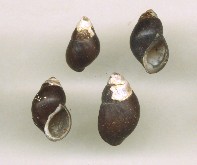
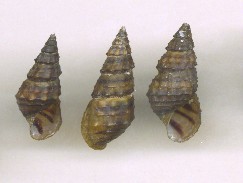
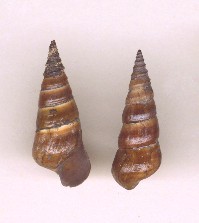
species.Pleurocera simplex (Say, 1825)* East TN
creeks. Usually has a black sooty deposit on outer
surface. Prefers fast moving water in small creeks,
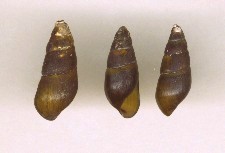
often crawling out well above the waterline.Pleurocera ebenum (Lea, 1841)* Upper
Cumberland River.
*formerly "Elimia" or "Goniobasis"Elimia aterina (Lea, 1836) Tributary
creeks to Clinch and Powell, TN. Now regarded
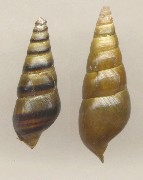
as synonymous with Pleurocera simplex.Pleurocera laqueta, from small tributary to Duck
River.Pleurocera laqueta*, Nolin River, KY. Pleurocera laqueta (Say, 1829)*, living in
Chickamauga Lake, TN. The quiet water habitat is
atypical for most snails formerly assigned to Elimia
or Goniobasis.Elimia interrupta (Haldeman, 1840)
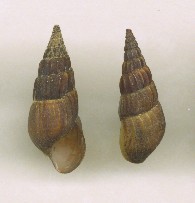
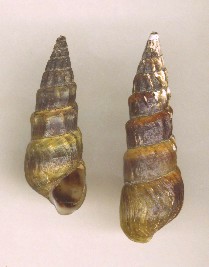
Hiwassee River and tributaries, East Tennessee.Pleurocera troostiana. East Tennessee creeks.
Like most species, varies in subtle ways from one
creek to another.
*formerly "Elimia" or "Goniobasis" arachnoidea.Lithasia armigera (Say, 1821) Tributaries of
the lower Ohio.Lithasia duttoniana (Lea, 1841) Duck River
and tributaries, Tennessee.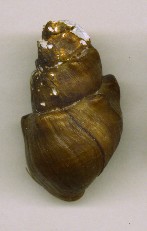
Lithasia geniculata geniculata (Haldeman,
1840), (left) and L. g. fuliginosa (Lea, 1841),
(right) Duck and Buffalo Rivers, TN.Lithasia verrucosa (Rafinesque, 1820) Ohio
River tributaries, also in Arkansas.Lithasia obovata (Say, 1829) Ohio
River tributaries.Leptoxis praerosa (Say, 1821) Tributaries
of the Ohio, Tennessee, and Cumberland.
Atlantic drainages
Pleurocera* virginica Say, 1817.
Eastern rivers and creeks, widespread.Pleurocera* catenaria postelli (Lea, 1858)
Georgia rivers.
Pleurocera* catenaria dislocata (?)
(Reeve, 1861) The left (striped) ones
are from the Nottaway, and the plain ones
(right) are from the Appomatox River,
both in Virginia.Pleurocera* catenaria var? South Carolina.
*formerly "Elimia" or "Goniobasis"
Leptoxis carinata (Bruguiere,
1792) Eastern rivers. Note small
projection on columella.Leptoxis carinata (Bruguiere, 1792) (?) Burch includes a number of
variable shells in this species. These came from (left to right) Roanoke River
in western Virginia, Appomatox River in central Virginia, Buffalo Creek in
central Virginia, and the Nottaway River in southeastern Virginia.
Gulf Coast Rivers
Elimia catenaria vanhyningiana
(Goodrich, 1921) Gulf Coast Florida.Elimia vanuxemiana (Lea, 1834) Georgia and
Alabama unimpounded rivers.Elimia gerhardti (Lea, 1862)
Coosa River basin of Alabama
and Georgia.
Western Mississippi drainages
Pleurocera acuta acuta Rafinesque,
1831. Osage River, MOPleurocera acuta acuta Rafin-
esque,1831. Gasconade River, MOPleurocera acuta acuta
Rafinesque, 1831. Eleven
point River, ArkansasElimia potosiensis (Lea, 1841)
White River, MOElimia potosiensis (Lea, 1841)
Weaubleau Creek, MOElimia potosiensis (Lea,
1841) Osage River, MO.
Pacific drainages of the Far West (Family Semisulcospiridae)
Juga plicifera (Lea, 1838) Oregon and Washington
rivers. The ones pictured are from near Portland, Oregon.Juga silicula (Gould, 1847) Oregon and
Washington creeks
In the rivers west of Seattle, all smaller
shells are ribbed, while larger ones show
that individuals have lost the ribbing at
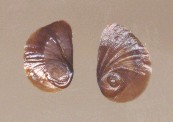
different times as they grow.Typical Juga operculum, inner
surface (left) and outer surface.Burch lists twelve species and subspecies (nine nominal species) in three subgenera for Juga. Several are endemic to springs in the interior Great Basin of Nevada.